Pages

December 29, 2009

Year In Review: Requiem For The Revolutions


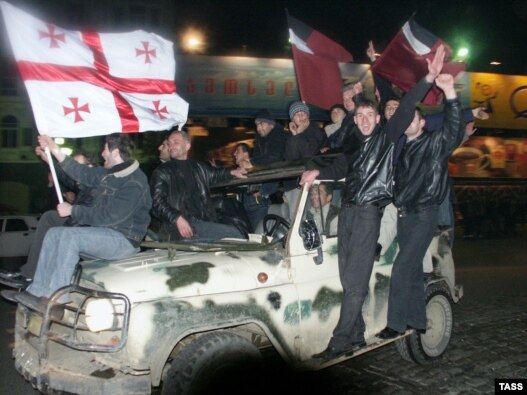
TBILISI -- In 1989, seven months before the Berlin Wall came down amid jubilant celebrations across Europe, Ghia Marghulia joined thousands in the center of the Georgian capital to protest Soviet rule.

Now the director of a Tbilisi public school, Marghulia sits in his office and recalls the tense and heady atmosphere two decades ago when, in the midst of Soviet leader Mikhail Gorbachev's perestroika-era reforms, Georgians contemplated the unthinkable -- breaking free from Moscow's grip and winning their independence.

"We had already swallowed some freedom and it was not possible to go back to the old limits," We made a lot of mistakes. We all yearned for freedom, but we did not prepare for this freedom
Marghulia says. "We began to talk about how Georgia needed to be a free country." We made a lot of mistakes. We all yearned for freedom, but we did not prepare for this freedom

But the Kremlin had other ideas. In the small hours of the morning on April 9, after days of demonstrations, Soviet troops moved in to surround the demonstrators, and attacked them with military batons and spades. Nineteen Georgians were killed, including a 16-year-old girl.

Tbilisi's bloody 1989 spring was followed by an autumn of change in Eastern Europe, when peaceful protests in places like Prague and East Berlin -- and more violent clashes in Romania -- toppled Soviet satellite regimes across Eastern Europe, brought down the Iron Curtain, and ended the Cold War.

As the world marked the 20th anniversary of the fall of the Iron Curtain this year, the different fates of the countries of the 1989 revolutions came sharply into focus. Former Soviet vassal states like Poland, Hungary, the Czech Republic, and Slovakia are free, stable, and prosperous democracies safely nestled in NATO and the European Union.

But countries like Georgia, Ukraine, and Moldova, which won their independence following the 1991 Soviet collapse, have experienced a tumultuous two decades as they struggled to fully break free from Moscow's grip, establish functioning democracies, and fully join the West.

Marghulia notes that most countries emerging from Soviet rule were simply not prepared for what came next once they achieved independence.

"We made a lot of mistakes. We all yearned for freedom, but we did not prepare for this freedom," Marghulia says.

"We all thought that when we got freedom, then everything else would take care of itself. We weren't prepared. We didn't prepare people to be good ministers, good administrators. We didn't have any concept about how to develop our state."

continue here
December 24, 2009

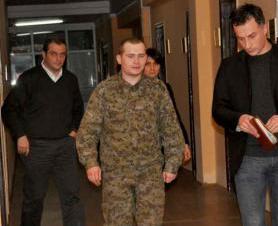
FSB Defector Describes 'Amoral' Conditions In South Ossetia


Vitaliy Khripun after his request for asylum in Georgia

December 24, 2009
Twenty-five-year-old Vitaly Khripun, a border guard with the Russian Federal Security Service in South Ossetia, defected from his post on December 21 and has asked for political asylum in Georgia. Khripun was serving in the Java district along the administrative border that has separated South Ossetia from Georgia proper since last year's five-day war between Russia and Georgia. In his first interview since his defection, Khripun says he was motivated to act by the culture of corruption and cruelty he witnessed in South Ossetia. He spoke to Olesya Vartanyan of Echo of the Caucasus, RFE/RL's Russian-language programming for Abkhazia and South Ossetia. The interview took place in Tbilisi on December 22.

RFE/RL: Where are you from originally?

Vitaly Khripun: I was born in Ukraine in 1984. Since 1986, I've lived in Russia. Well, it was all the Soviet Union back then. In Murmansk.

RFE/RL: How long have you been in the military?

Khripun: I finished my conscription in 2004. After that, I went to sea, and then I applied to the Federal Security Service.

RFE/RL: When did you become an employee of the FSB?

Khripun: On May 27, 2008.

RFE/RL: Where did you serve?

Khripun: In Murmansk, in the coast guard of the FSB. And then I was sent to Ossetia. I assumed duty there on December 9, 2009.

RFE/RL: Was your military service in Murmansk different from what you've experienced since in South Ossetia?

Forget your way back to Abkhazia!


Forget your way back to Abkhazia!


We drove to a point we were not supposed to. It was on the Enguri bridge. We were three of us one US citizen, on Georgian citizen and me. We passed by Georgian checkpoints and entered the territory controlled by Abkhaz without knowing it. We were supposed to leave the US citizen, lets name him Nick, at the checkpoint, so that he would continue his way to Abkhazia and we would return back to Zugdidi. When I talk of checkpoint, I mean a point where Abkhazian officers check the documentation of those who travel to and forth. This checkpoint on the Enguri river is the only official gate between Georgia and Abkhazia. Though, Bagapsh, in his visit to Gali region within an election campaign pledged to establish 5 more official gates.

We approached this gate. The first reaction of Abkhaz, standing there, was confusion as it was a car with Georgian numbers approaching. One Abkhaz officer came closer demanded our documents. We were told that we illegally crossed the “state border.” We tried to explain the situation, meanwhile, everybody around was looking at us in horror. We, with Georgian numbers, were most unwelcome guests there.

On the other side of the checkpoint, we saw a group of people, most probably Gali residents, who were waiting to be allowed to cross to the Georgian proper. They were mainly women and elderly. Abkhaz officers were rudely shouting at them: Shut up now, or you will have to go back home.

After explaining the situation, he took Nick and Giorgi’s (not a real name for the Georgian citizen) documents and lead us to a room where documents were checked. We saw two other officers there, both of them around 40. They checked Nick’s documents and as he had it all right, asked him to leave the room. What shocked me was a dialogue between Giorgi, himself an IDP from Abkhazia and Abkhaz officers.

- So, your name and surname: Giorgi Korkia (invented name)
- So your ID card says you are born in Sukhumi: Yes I am
- Where do you live now? In Tbilisi, in a hotel.
- Where did you live in Sukhumi? Close to the University
- Which school did you go? School no 1.
- Where is your family now? In Tbilisi, I live together with my parents in a hotel.
- You know you crossed the state border illegally? No I did not know, just wanted to leave the foreigner.
- Well, you did so, we will solve the issue now….- and he started to call…he was never responded. Meanwhile, he got angrier
- What about the car? – The car belongs to an organization where this foreigner works.
- What about this girl? Pointing at me. – She is his colleague…
- Well, we could solve this problem right now, but, you’d better disappear from here as soon as possible. - he said after writing down all the details of his identity card. Then he rudely threw documents back to Giorgi - And, forget your way back to Abkhazia Giorgi Korkia….

The atmosphere during this dialogue was very hostile. Faces of Abkhazian officers expressed nothing but a disgust and anger. Giorgi tried to be calm, if that was even possible.

Officer never asked me any question, most probably because I was a woman and they could not figure out my nationality.

We left the area quickly. Giorgi was speechless for some time.
- did you see how they treated me? He said finally- if only you know what I, with my family, had to go through when we were kicked out…. – he was shaking out of the humiliation.

Chechen President Confesses


Chechen President: 

"...Georgia, South Ossetia, Ukraine, all this will go on and on. It's Russia's private affliction. Why should we always suffer if we can eradicate this for good? We are a great power, we have everything - an army, technology. We need to attack."

"And if not," he added, "we have a very strong politician of global stature, Vladimir Vladimirovich Putin. There is no one like him on the world stage."


December 18, 2009

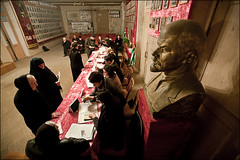
Elections Under His Eyes


***
Originally uploaded by Avdeev Max


"Members of election committee seen at a polling station in the village of Duripsh some 70 kilometers from Sukhumi capital of Georgian breakaway region of Abkhazia. The portraits in background are victims and heroes of Georgia-Abkhazia war in 1993. 12.12.09"
writes Avdeev Max


I am looking at this picture and can't believe that this world of soviets still exist. Are you sure it's not some old film from soviet era? Is it all real?

December 15, 2009

Surprise

Surprise

On 4 November, teenagers from village Tirdznisi, Gori region, Georgia were detained by law enforcement agencies of South Ossetia. They were accused of possession of explosives (according to the article 222 of Criminal Code of Russian Federation) and illegally crossing the state border (according to the  article 322 of Criminal Code of Russian Federation)

source: http://cominf.org/node/1166481620  in Russian

The article 322 of Criminal Code of Russian Federation reads:

Illegal Crossing of the State Border of the Russian Federation

1. Crossing of the protected State Border of the Russian Federation without official documents and a proper permit,shall be punishable by a fine in the amount of 200 to 500 minimum wages, or in the amount of the wage or salary, or any other income of the convicted person for a period of two to five months, or by deprivation of liberty for a term of up to two years.
2. Illegal crossing of the protected State Border of the Russian Federation, committed by a group of persons in a preliminary conspiracy, or by an organized group, or with the use of violence or threats of its use, shall be punishable by deprivation of liberty for a term of up to five years.

So, is "independent" South Ossetia South Ossetia or Russia?


-----------------

"несовершеннолетние граждане Грузии, жители с. Тирдзниси Горийского района Грузии были задержаны правоохранительными органами Южной Осетии 4 ноября. Следственное управление МВД РЮО возбудило на задержанных уголовное дело по факту незаконного хранения взрывчатых веществ (ст. 222 УК РФ) и незаконного пересечения государственной границы (ст. 322 УК РФ). http://cominf.org/node/1166481620

В статье 322.  УК РФ написано:

Незаконное пересечение Государственной границы Российской Федерации.

1. Пересечение охраняемой Государственной границы Российской Федерации
без установленных документов и надлежащего разрешения -
наказывается штрафом в размере от двухсот до пятисот минимальных размеров
оплаты труда или в размере заработной платы или иного дохода осужденного за
период от двух до пяти месяцев либо лишением свободы на срок до двух лет.
2. Незаконное пересечение Государственной границы Российской Федерации,
совершенное группой лиц по предварительному сговору или организованной группой
либо с применением насилия или с угрозой его применения, -наказывается лишением свободы на срок до пяти лет.

Значит, "независимая" Южная Осетия - эта Южная Осетия или Россия?


video: http://media.interpressnews.ge/main.php?g2_itemId=1827 

December 14, 2009

Free and Fair Magic


Today some news channels announced re-election of Mr. Bagapsh in Abkhazia. Some of them said about election: "It was free and fair, democratic." Somehow in democratic Abkhazia ethnic Georgians are not allowed to vote. Let us know what you think about the issue. Very interesting is opinion of Abkhazians, is it all free and fair?

Links:

December 8, 2009

December 5, 2009

Homo Sovieticus


15 January

"In Moscow there is a fuss over a new history textbook. Members of United Russia are demanding that Putin should require that 'pride at the events' of the Russo-Finnish War of 1939 and Stalin's collectivisation of agriculture should be included. They insist that our children should once more read a Soviet treatment of the Second World War and the supposedly positive role played by Stalin. Putin is going along with this. Homo sovieticus is breathing down our necks. Another textbook has meanwhile been banned for including the comment by Academician Yanov that Russia is in danger of turning into a national socialist state armed with nucler weapons."

"The authorities are insinuating ever more busily, on television and in speeches by their most prominent figures, that Stalin was really not as bad as he was subsequently made out to be.
...Re-Stalinisation is a reality."
- Writes Anna Politkovskaya in her Book "A Russian Diary”.

You really have to read it, as Russia is very important player in our region. You need to know with whom you are friends. If you can't find the Book in your country, ask yourself, what are the reasons? Why it is not available? But these aren't the questions I am writing this post about. My real question is about a miracle that Abkhazian’s blame Georgia for the actions of the people they have never elected. Neither Stalin nor Beria was appointed by Georgians. Kremlin, where all power came from, made them political figures. Who brought Kadyrov junior in power? He represents in my eyes Moscow's politics. If Putin were against the unjust what was happening to many people, he wouldn’t promote Kadirov to keep on going his way. Even after many crimes, after dead of many journalists and after many unjust, which are still happening to many Caucasian families, Putin is still asking Kadirov to torture. What do I want to say with it? My point is, once you have power over other country and take control in your hands, you can find in any country and in any nation a dog that eats other dogs. Red army has occupied Georgia and Abkhazia as well, Stalin and Beria were chosen from Moscow and not from Tbilisi, because they were people, whom soviet Russia needed. I don't get why Georgians have to be blamed for the Soviet heroes? Many ethnic Georgians had suffered under their brutal regime too.

In public speeches, when there is mood to blame Georgians, Stalin is Georgian, who made horrible things to Abkhazians. Private though "Stalin is a hero", whose museum-Dacha is national pride of Abkhazia, powerful and memorable. "And actually he is not Georgian at all. Don't you know his father was Ossetian?" - asks me my friend from the other side. I am confused, really. I think over this issue is total misunderstanding between Georgians and Abkhazians and at least we could remove it from our way with answerin some questions. First, is Stalin Abkhazian’s enemy or a hero? Second, who has created Stalin-Power, was it Moscow or Tbilisi? And last question, who is proud child of this dictator in our modern time?

I don't know what your answers are, but I know mines. And everything is so ironic, especially Abkhazian side serving Stalin's descendant, who can't have long term interest to support one more Caucasian nation. Some people are smart though. They guess what Russia's only real plans could be, but still favor, as they say "let the beast help them out of problem" and use it to destroy their neighbouring nation. Same people blame Georgia for being traitors long ago, because of not helping Abkhazians against soviet army. ...Aren’t we facing some what similar actionstoday, now from Separatist side? Aren’t these actions carried on with being proud of it? Why? We have nobody so close and related to us as WE ARE to one another. I am afraid I talk here about farther issues and for now, please let us just answer on the questions mentioned above to have at least one disagreement less in the next year :)

Abkhaz-Georgian Dictionary

Time after time I will be adding some words to our Abkhaz-Georgian Dictionary.
If you want to help me by this, please just comment new words with translations as a comment below.

Thank you!


Full view here >>

December 4, 2009

Internet For PEACE


We have finally realized that the Internet is much more than a network of computers.

It is an endless web of people. Men and women from every corner of the globe are
connecting to one another, thanks to the biggest social interface ever known to humanity.
Digital culture has laid the foundations for a new kind of society.
And this society is advancing dialogue, debate and consensus through communication.
Because democracy has always flourished where there is openness, acceptance,
discussion and participation. And contact with others has always been the most
effective antidote against hatred and conflict.
That's why the Internet is a tool for peace.
That's why anyone who uses it can sow the seeds of non-violence.
And that's why the next Nobel Peace Prize should go to the Net.

A Nobel for each and every one of us.

http://www.internetforpeace.org/manifesto.cfm